
GloVANet Academy Week

GloVANet is excited to announce that it has launched a “GloVANet Academy Week“! GloVANet’s mission is to provide knowledge, tools, and education, based on the latest science and consensus, for all involved in vascular access, to have the best infusion technology for optimal patient care everywhere in the world. In accordance with this mission, GloVANet is organising its first Academy Week in which VA-specialists can follow hands-on courses given by experts in the field for 4 consecutive days.
The GloVANet Academy Week will take place from Monday 8 to Thursday 11 March 2027 at the Corendon Hotel, Amsterdam, Schiphol Airport, The Netherlands.
The programme consists of a total of 24 courses. For these courses there are 7 topics that will be given at multiple occasions during the week in order to ensure you can attend the largest variety of courses possible.
The 7 courses are:
- Course A: PICC-ports: indication and technique of implantation (PICC-Port)
- Course B: The intracavitary ECG method for tip location of central VADs (IC-ECG)
- Course C: Ultrasound-based tip location with bubble test: the ECHOTIP protocol (EchoTip)
- Course D: Ultrasound evaluation of deep veins: RaCeVA, RaPeVA, RaFeVA (RaCeVA etc)
- Course E: Femoral access for peripheral VADs, central VADs, and ports (Femoral)
- Course F: Long peripheral catheters: indication and technique of insertion (LPC)
- Course G: Tunneling: indications and techniques according to the RAVESTO protocol (Tunneling)
Below you can find an overview of the course programme for the 4 days. By clicking on the image you will be redirected to a PDF-file for you to download.
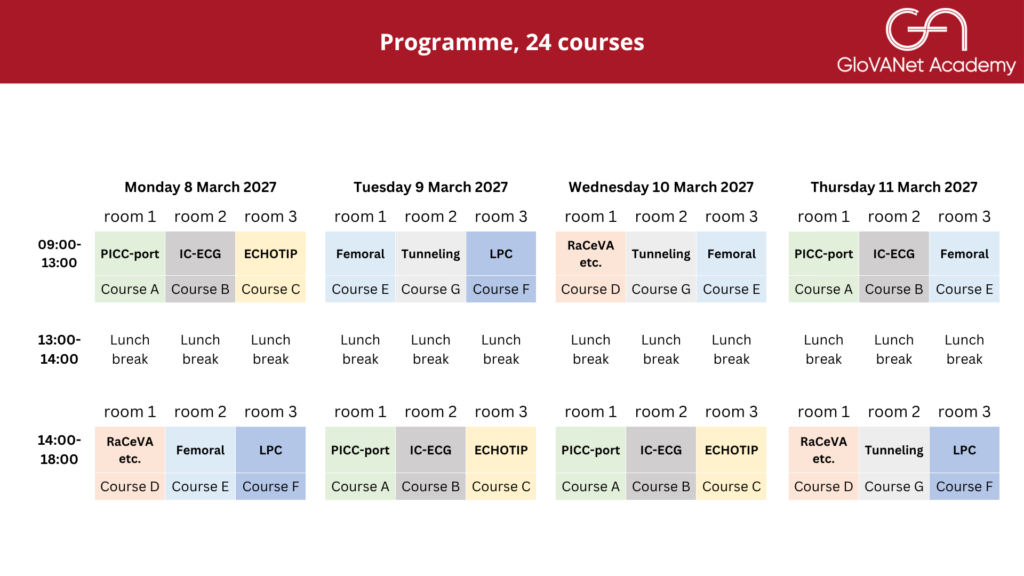
The GloVANet Academy Week programme consists of 7 different VA related courses, that will be given multiple times, which results in a total of 24 courses given in 4 days. This is done to ensure that you can attend all 7 courses if you would like to and that you can select different days to attend. You can choose as little or as many trainings as you like.
Every day there are 3 trainings in the morning from 09:00 to 13:00 hrs. and in the afternoon from 14:00 to 18:00 hrs.
For each course there will be 2 teachers and there is a maximum capacity for 10 participants per course.
Below you will find the different training per day.
Monday 8 March 2027
09:00 – 13:00
Course A: PICC-ports indication and technique of implantation (PICC-Port)
Course B: The intracavitary ECG method for tip location of central VADs (IC-ECG)
Course C: Ultrasound-based tip location with bubble test: the ECHOTIP protocol (EchoTip)
14:00 -18:00
Course D: Ultrasound evaluation of deep veins: RaCeVA, RaPeVA, RaFeVA (RaCeVA etc)
Course E: Femoral access for peripheral VADs, central VADs, and ports (Femoral)
Course F: Long peripheral catheters: indication and technique of insertion (LPC)
Tuesday 9 March 2027
09:00 – 13:00
Course E: Femoral access for peripheral VADs, central VADs, and ports (Femoral)
Course G: Tunneling: indications and techniques according to the RAVESTO protocol (Tunneling)
Course F: Long peripheral catheters: indication and technique of insertion (LPC)
14:00 -18:00
Course A: PICC-ports indication and technique of implantation (PICC-Port)
Course B: The intracavitary ECG method for tip location of central VADs (IC-ECG)
Course C: Ultrasound-based tip location with bubble test: the ECHOTIP protocol (EchoTip)
Wednesday 10 March 2027
09:00 – 13:00
Course D: Ultrasound evaluation of deep veins: RaCeVA, RaPeVA, RaFeVA (RaCeVA etc)
Course G: Tunneling: indications and techniques according to the RAVESTO protocol (Tunneling)
Course E: Femoral access for peripheral VADs, central VADs, and ports (Femoral)
14:00 -18:00
Course A: PICC-ports indication and technique of implantation (PICC-Port)
Course B: The intracavitary ECG method for tip location of central VADs (IC-ECG)
Course C: Ultrasound-based tip location with bubble test: the ECHOTIP protocol (EchoTip)
Thursday 11 March 2027
09:00 – 13:00
Course A: PICC-ports indication and technique of implantation (PICC-Port)
Course B: The intracavitary ECG method for tip location of central VADs (IC-ECG)
Course E: Femoral access for peripheral VADs, central VADs, and ports (Femoral)
14:00 -18:00
Course D: Ultrasound evaluation of deep veins: RaCeVA, RaPeVA, RaFeVA (RaCeVA etc)
Course G: Tunneling: indications and techniques according to the RAVESTO protocol (Tunneling)
Course F: Long peripheral catheters: indication and technique of insertion (LPC)
Below you will find more detailed descriptions of the different VA courses of the GloVANet Academy Week as well as what the practical sessions will include. The maximum capacity of each course is 10 participants
Course A – PICC-ports: indication and technique of implantation (PICC-Port)
PICC ports are a new-generation arm port, inserted using the same techniques as PICC insertion (ultrasound-guided venipuncture of a deep vein in the arm, ultrasound-based tip navigation, and tip location by ultrasound or intracavitary ECG).
This practical session will include two hands-on skill stations:
– Choice of the site of venipuncture, of the site for implantation of the reservoir, and of the dimensions of the reservoir, using the RaPeVA protocol and the ZIM protocol (on volunteers).
– Implantation of the reservoir and closure of the skin incision with intradermal sutures and cyanoacrylate glue (on simulators).
Course B – The intracavitary ECG method for tip location of central VADs (IC-ECG)
Most guidelines currently recommend intracavitary ECG as the first option for tip location, as it is recognized as more accurate, safer, and more cost-effective than X-ray.
This practical session will include two hands-on skill stations:
– Demonstration of proper placement of electrodes and proper connection between the ECG monitor and the central venous catheter (on simulator and volunteers).
– Demonstration of the different ECG tracings obtained during progression of the catheter tip towards the atrium, with explanation of the different shapes of the P wave (on simulator).
Course C – Ultrasound-based tip location with bubble test: the ECHOTIP protocol (ECHOTIP)
Although the current gold standard for tip location is intracavitary ECG, many studies over the past decade have demonstrated the feasibility and accuracy of ultrasound-based tip location using transthoracic echocardiography with a bubble test.
This practical session will include two hands-on skill stations:
– Ultrasound-based localization of the tips of FICCs and FICC-ports using the transhepatic and subcostal views, according to the revised ECHOTIP protocol (on volunteers).
– Ultrasound-based localization of the tip of PICCs, PICC-ports, CICCs, and chest ports, using subcostal and apical views, according to the revised ECHOTIP protocol (on volunteers).
Course D – Ultrasound evaluation of deep veins: RaCeVA, RaPeVA, RaFeVA (RaCeVA etc.)
All current international guidelines strongly recommend pre-procedural ultrasound evaluation of the deep veins to optimize venipuncture site selection before central venous catheterization.
This practical session will include two hands-on skill stations:
– Ultrasound evaluation of the deep veins in the supra/infraclavicular area and detection of pneumothorax before insertion of CICC and chest ports, according to the RaCeVA protocol (on volunteers).
– Ultrasound evaluation of the deep veins of the upper limbs (before PICC and PICC-ports insertion) and of the lower limbs (before FICC and FICC-ports insertion), according to the RaPeVA and RaFeVA protocols (on volunteers).
Course E – Femoral access for peripheral VADs, central VADs, and ports (Femoral)
The clinical practice of femoral access has changed in the last few years, with the introduction of new venous approaches (superficial femoral vein) and new methods for tip location (ultrasound).
This practical session will address these advances in two hands-on skill stations:
– Ultrasound-based evaluation of the veins of the lower limb according to the RaFeVA protocol, and selection of the most appropriate exit site according to the RAVESTO protocol (on volunteers)
– Ultrasound-based localization of the tip of femoral catheters using the transhepatic and subcostal views, according to the revised ECHOTIP protocol (on volunteers).
Course F: Long peripheral catheters: indication and technique of insertion (LPC)
Long peripheral catheters are 6-15 cm long peripheral venous access devices inserted in the superficial and deep veins of the upper limb. They are available in different designs and with different insertion techniques, which have been discussed and standardized in the SILPeC protocol.
This practical session will include two hands-on skill stations:
– Ultrasound evaluation of the superficial and deep veins of the upper limbs (forearm and upper arm), for choosing the proper insertion site of LPCs (on volunteers).
– Demonstration of the different techniques of LPC insertion, with and without ultrasound guidance, according to the SILPeC protocol (on a simulator).
Course G – Tunneling: indications and techniques according to the RAVESTO protocol (Tunneling)
Tunneling has rapidly entered clinical practice, not only for cuffed catheters but also for non-cuffed PICCs, CICCs, FICCs, totally implanted VADs, and peripheral VADs.
This practical session will include two hands-on skill stations:
– Differentiation between puncture and exit sites, with examples of tunneling options, according to the RAVESTO protocol (on volunteers).
– Different tunneling techniques using different tools (on simulators)
The VA courses will be given by experienced vascular specialists that are linked with GloVANet and WoCoVA. Below you will find a list of teachers that will give the different courses.
Course Director: Mauro Pittiruti
Teachers:
Tim Spencer
Fulvio Pinelli
Gloria Ortiz Miluy
Fabrizio Brescia
Antonio Gidaro
Maria Giuseppina Annetta
Davide Giustivi
Mauro Pittiruti
The GloVANet Academy Week will be given at the following location:
Corendon Amsterdam Schiphol Airport, A Tribute Portfolio Hotel
Schipholweg 275
1171 PK Badhoevedorp
The Netherlands
For delegates of the GloVANet Academy weeks there is a special rate. In the registration confirmation email, the link to the hotel booking will be shared.
Roomrate is €169 for single occupancy. This includes breakfast, internet, city tax and VAT.
Registration can be done for only 1 course, but you can also select multiple courses, up to 7 courses. Of course, it is more cost effective if you choose to do multiple courses.
The cost for each course is €350.
Included is a welcome coffee, a coffee break and a certificate of attendance.
Options to choose at additional costs:
- Lunch €20
- Dinner €35
- Network drinks at the end of each day (no additional costs, but registration is necessary)
